For millions of drivers, the daily commute has quietly stretched beyond the classic 30-minute hop. In major metropolitan areas across Asia, Europe, and North America, three-hour round trips are no longer rare. What used to be an occasional long drive has become routine—and the human body is paying the price. Lower-back fatigue, stiff hips, and the dull ache that settles in after the second hour are now common complaints. Traditional foam seats with fixed lumbar supports simply cannot keep pace.
Enter the new generation of automotive seating: adaptive air lumbar systems combined with multi-mode massage. What began as a premium luxury feature is rapidly becoming the practical standard for anyone who spends significant time behind the wheel.
The Limitations of Conventional Seating
Standard vehicle seats rely on static foam contouring and, at best, a manually adjustable lumbar bolster. Once the driver settles into a position, the seat remains largely unchanged for the duration of the journey. Over time, pressure points develop, blood circulation slows, and the lumbar spine loses its natural curve. Studies on occupational driving have long linked prolonged static posture to increased risk of chronic lower-back pain and reduced alertness.
For three-hour commuters, these effects compound. The final hour of a long drive is often the most fatiguing, precisely when concentration should be highest. Adaptive air systems address this by treating the seat as a dynamic support surface rather than a passive cushion.
How Adaptive Air Lumbar Works
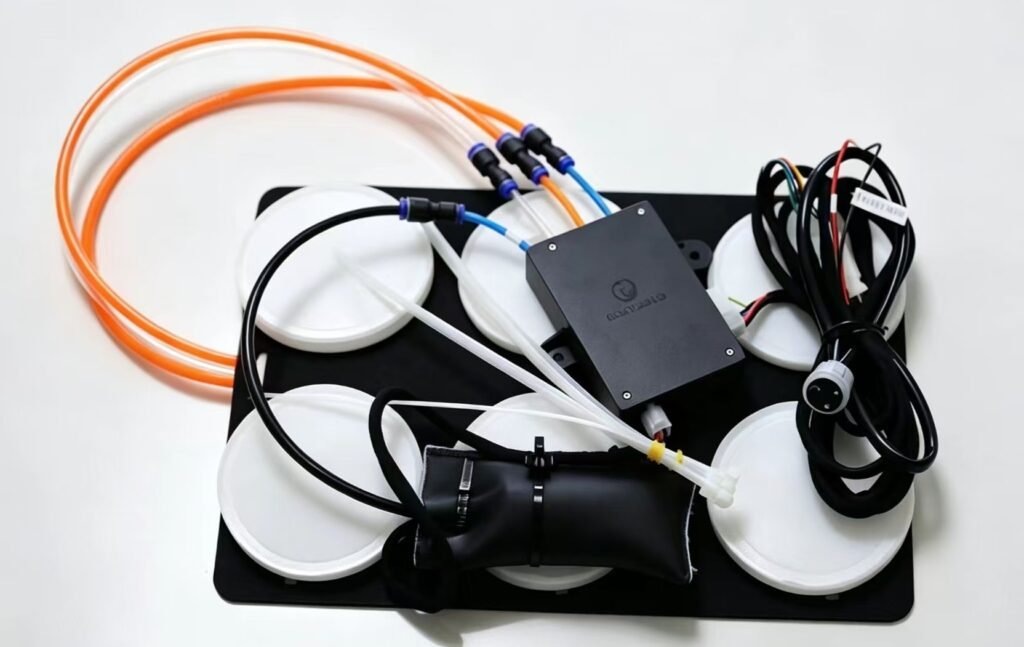
At the core of the technology is a network of independently controlled air bladders embedded in the seatback. Unlike older single-chamber lumbar supports, modern systems typically use four to eight (sometimes more) discrete air cells arranged vertically and laterally. Sensors—or, in more advanced setups, continuous pressure mapping—monitor the driver’s posture and weight distribution in real time.
An electronic control unit then adjusts air pressure in individual bladders within seconds. The result is a lumbar support that can:
- Expand or contract to maintain the spine’s natural lordotic curve
- Shift support higher or lower as the driver changes posture
- Provide asymmetric pressure to counteract leaning or uneven loading
Many systems also incorporate side bolsters that gently firm up during cornering, improving lateral stability without the need for aggressive fixed bolsters that can feel restrictive on long highway stretches.
The Massage Layer: From Novelty to Function
Massage functions have evolved far beyond the simple vibration motors of the early 2010s. Current systems use sequenced air-bladder inflation to create wave-like, kneading, or tapping motions across the lower and mid-back. Some high-end implementations add targeted pressure points along the paraspinal muscles.
The key advancement is integration. Instead of running as a separate “massage mode,” the system can operate in background support mode: subtle, low-amplitude movements that promote micro-circulation and prevent muscle stiffness without distracting the driver. For longer journeys, full massage cycles can be scheduled or triggered by fatigue-detection algorithms that monitor steering behavior, eyelid closure, or heart-rate variability via steering-wheel or seat sensors.
Real-World Benefits for the 3-Hour Commute
Drivers who switch to adaptive air lumbar and massage systems consistently report three measurable improvements:
- Reduced perceived fatigue – Many users describe feeling “fresher” at the end of a long drive, with less residual lower-back tightness the following morning.
- Improved posture maintenance – Continuous micro-adjustments help prevent the gradual “slump” that occurs after 60–90 minutes in a static seat.
- Enhanced alertness – Mild dynamic stimulation appears to counteract the drowsiness that often sets in during monotonous highway driving.
From a safety perspective, anything that delays the onset of physical discomfort also delays the decline in reaction time and attention that accompanies it. Fleet operators and ride-hailing companies are beginning to take notice; several large operators in China and Europe have started specifying adaptive lumbar systems in new vehicle orders precisely because of the link between driver comfort and incident rates.
Technology Maturity in 2026
By 2026, the technology has moved well beyond flagship luxury models. Mid-range electric vehicles from Chinese, Korean, and European manufacturers increasingly offer multi-chamber air lumbar as standard or as a widely available option. The cost of the pneumatic hardware and control electronics has fallen sharply thanks to high-volume production and shared platforms with other vehicle systems (air suspension, for example).
Software sophistication has also improved. Early systems required the driver to select modes manually. Current generations learn preferred pressure profiles over time and can adapt support intensity based on road type, driving style, or even the presence of a passenger. Some systems now coordinate with the vehicle’s climate control, slightly increasing lumbar firmness when cabin temperature rises to counteract the softening effect of heat on foam and muscle tone.
Looking Ahead
The next frontier is predictive and personalized support. Future systems will combine seat pressure data with biometric inputs and navigation information to anticipate posture needs—firming support before a long series of curves, or initiating a recovery massage sequence as the vehicle approaches the end of a known commute route.
Integration with broader cabin wellness features is also accelerating. Adaptive lumbar is increasingly paired with ventilated or heated surfaces, active noise cancellation, and circadian lighting to create a coherent “recovery environment” inside the vehicle.
For the growing population of drivers who treat their cars as mobile offices or extended living spaces, static seating is no longer adequate. Adaptive air lumbar combined with intelligent massage is not merely a comfort upgrade; it is becoming the baseline requirement for sustainable long-distance driving. Three-hour commutes are unlikely to disappear. The seats that support them, however, are finally catching up.