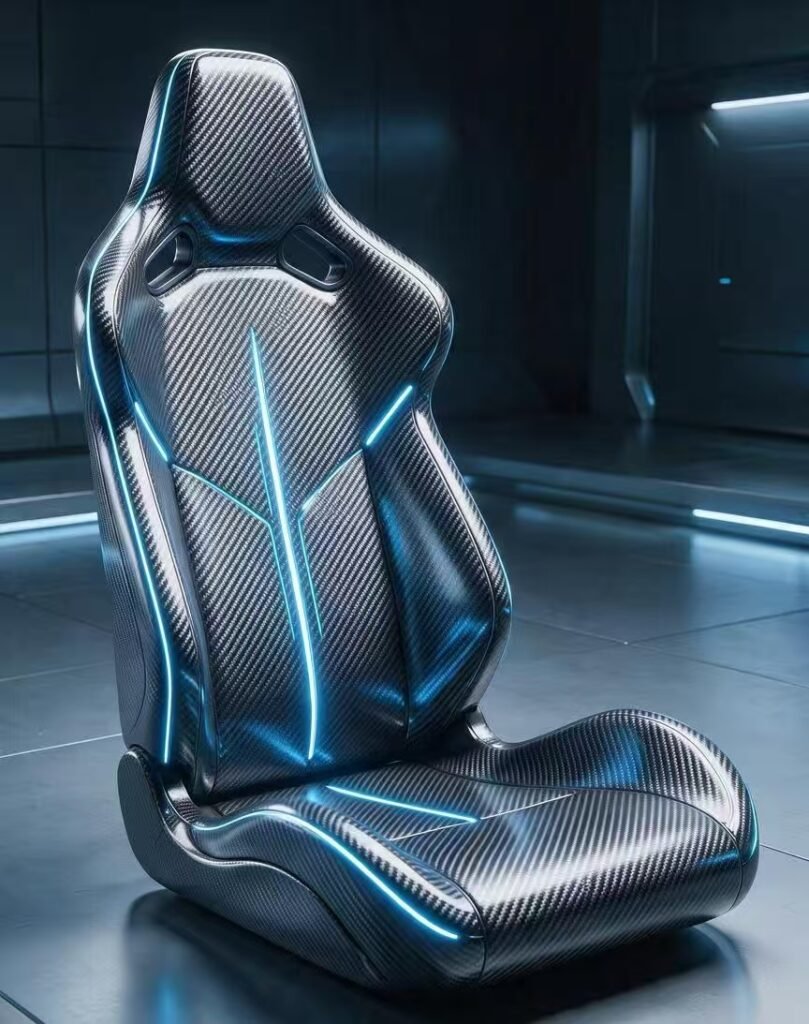
In the competitive landscape of electric vehicle (EV) cabin comfort, seat heaters have evolved from simple resistive wires into sophisticated thermal systems. Carbon fiber has clearly dominated the 2025–2026 market, delivering rapid, uniform surface heating with excellent flexibility and lower energy draw than traditional metal-wire designs. Yet pure carbon-fiber heaters still face a fundamental limitation: once power is cut or reduced, heat dissipates relatively quickly through the seat foam and into the cooler cabin air. Drivers experience a noticeable drop in perceived warmth during stop-and-go traffic, short trips, or when the system cycles to conserve battery range.
The next logical step is a hybrid architecture that pairs carbon fiber’s fast electrical response with the latent-heat storage of phase-change materials (PCMs). This combination aims to deliver both near-instant warm-up and extended heat retention, reducing overall energy consumption while improving real-world comfort consistency.
The Core Principle: Active Heat Generation Meets Passive Thermal Buffering
Carbon fiber (or carbon-nanotube/graphene-enhanced variants) functions as the active heating element. When voltage is applied, the conductive network generates heat rapidly and distributes it evenly across the seating surface. Typical high-performance carbon-fiber pads reach comfortable surface temperatures (around 30–38 °C at the skin interface) in under 90 seconds, with temperature variance often held to ±2 °C.
Phase-change materials operate on a different physical principle. Selected PCMs—commonly paraffin-based organics, salt hydrates, or engineered eutectics with transition temperatures in the 30–40 °C comfort range—absorb large amounts of latent heat as they melt and release that heat as they solidify, all while remaining nearly isothermal. When integrated into a thin layer adjacent to or interwoven with the carbon-fiber heater, the PCM acts as a thermal buffer:
- During the initial power-on phase, excess heat from the carbon fiber is absorbed by the PCM, preventing overshoot and protecting foam and cover materials.
- Once the desired surface temperature is reached, the heater can cycle off or drop to a lower duty cycle. The PCM slowly releases stored heat, maintaining warmth for a longer period.
- In mild conditions or during brief stops, residual PCM heat can delay or reduce the need to re-energize the heater.
Older patents and research dating back more than a decade already demonstrated that embedding PCMs in seat structures can double the interval between heater cycles and limit post-heating temperature rise. More recent work on carbon-fiber or carbon-felt composites with PCMs (primarily for battery thermal management) has shown substantial gains in thermal conductivity—sometimes exceeding 100 % improvement—while preserving useful latent-heat capacity. These advances make thin, flexible hybrid layers practical for automotive seats.
Performance Advantages in Practice
Faster effective warm-up and better uniformity.
Carbon fiber still provides the primary rapid response. The PCM layer does not slow the initial rise; instead, it smooths temperature gradients and absorbs transient peaks. Infrared mapping of pure carbon-fiber systems already shows excellent uniformity (±2 °C). Adding a well-dispersed PCM composite can further stabilize the surface against localized cooling from body contact or airflow.
Longer heat retention and reduced duty cycle.
Once charged, the PCM continues to release heat after the electrical element is switched off or power-modulated. This is particularly valuable in EVs, where every watt drawn from the high-voltage battery affects range. Research on PCM thermal storage for cabin heating has shown meaningful reductions in continuous electrical demand. Applied at the seat level, the same principle allows the heater to operate at a lower average power while keeping the occupant in the comfort zone longer.
Energy efficiency and range protection.
Modern carbon-fiber heaters already consume less power than legacy wire systems (often 20–50 % reductions reported in recent planar designs). Layering PCM further lowers the time-averaged consumption by extending the off periods. In cold-weather EV operation, where cabin heating can otherwise erode range significantly, localized seat heating with thermal buffering becomes one of the highest-leverage comfort strategies.
Enhanced comfort and material protection.
The isothermal nature of the phase transition reduces the “hot-spot then cool-down” sensation common with pure resistive systems. It also limits peak temperatures experienced by the foam and leather or fabric covers, potentially improving long-term durability.
Material and Design Considerations
Successful hybrid layers require careful engineering:
- PCM selection and encapsulation. Micro- or nano-encapsulated PCMs prevent leakage and maintain mechanical flexibility. Transition temperature must align with human thermal comfort (typically 32–38 °C for seating surfaces).
- Thermal conductivity enhancement. Pure PCMs have low conductivity. Incorporating carbon fiber, carbon nanotubes, graphene, or expanded graphite into the PCM matrix dramatically improves heat transfer into and out of the storage medium—exactly the approach validated in carbon-fiber/PCM composites for battery packs.
- Thickness and integration. The hybrid stack must remain thin (ideally under 2–3 mm total) so it does not compromise seat ergonomics or ventilation channels. Roll-to-roll or lamination processes already used for carbon-fiber and CNT planar heaters can be adapted.
- Safety and durability. The system must survive the same rigorous tests applied to current carbon-fiber pads: high-pressure kneeling cycles, temperature shock, humidity, and electrical safety standards. Shape-stable or form-stable PCM composites help meet these requirements.
Challenges Still to Be Overcome
Cost remains a primary barrier. High-quality microencapsulated PCMs and the additional processing steps increase material and manufacturing expense relative to pure carbon-fiber pads. Long-term cycling stability of the PCM under millions of seating cycles and temperature swings must be proven at automotive scale. Packaging to prevent any risk of leakage or degradation over a 10–15 year vehicle life is non-negotiable. Finally, control algorithms need refinement so the system intelligently decides when to charge the PCM versus simply maintaining surface temperature.
Outlook for 2026–2028
Carbon fiber will continue to dominate near-term production because of its proven performance, supply chain maturity, and cost trajectory. Hybrid carbon-fiber + PCM layers are more likely to appear first in premium or efficiency-focused EV platforms where the range and comfort benefits justify the incremental cost. As PCM encapsulation technology matures and carbon-enhanced composites become cheaper (building on battery-thermal-management volumes), the hybrid approach can migrate into mid-range vehicles.
The broader industry trend favors localized, high-efficiency thermal solutions over bulk cabin heating. Hybrid heating layers fit squarely into that direction: they deliver the instant gratification drivers expect from modern seat heaters while adding the thermal inertia needed for real-world energy savings and consistent comfort. In the coming model years, the most advanced seats may no longer simply heat—they will store, buffer, and intelligently release warmth as well.
By uniting the rapid response of carbon fiber with the latent-heat capacity of phase-change materials, engineers are creating a more complete thermal system. The result is seats that warm up quickly, stay comfortable longer, and place a lighter burden on the vehicle’s energy budget—exactly the combination the next generation of electric vehicles demands.