
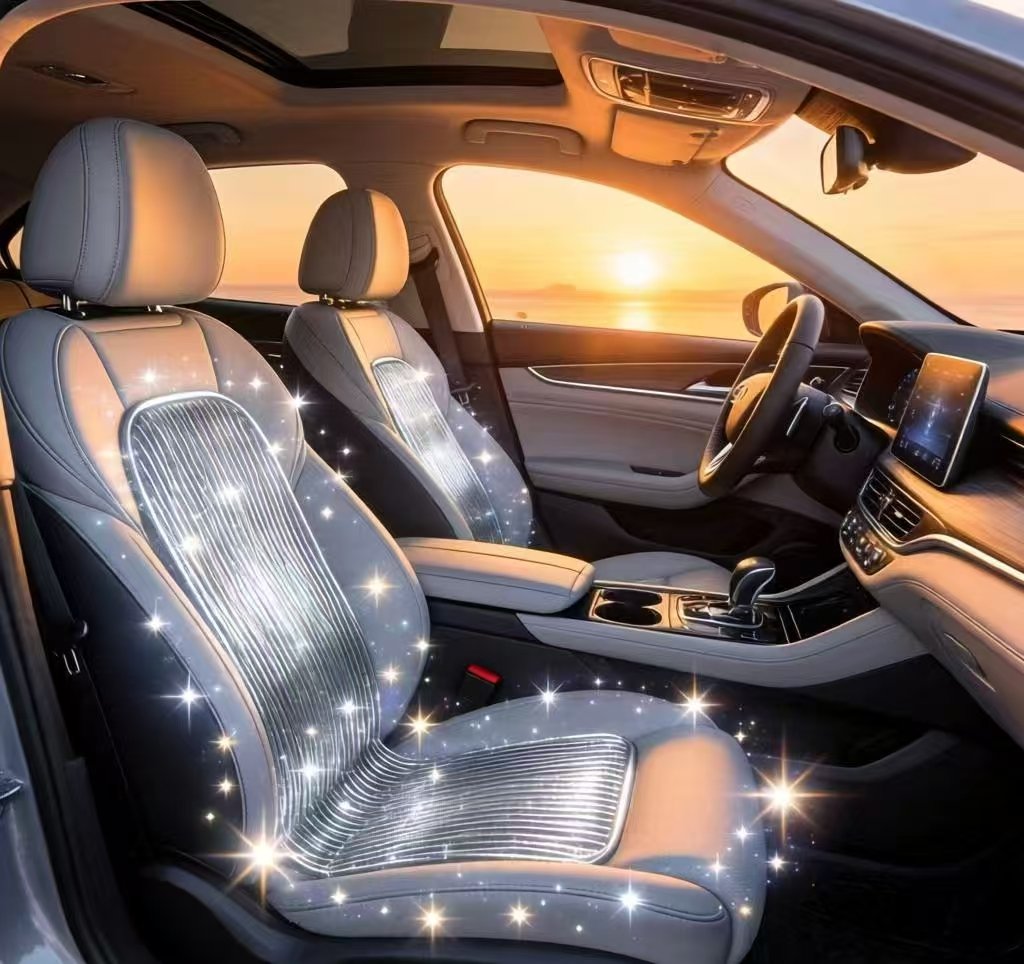
In the rapidly evolving world of automotive comfort systems, carbon fiber has dominated seat heater technology for years. It offers rapid heating, excellent uniformity, durability under mechanical stress, and strong energy efficiency compared to traditional resistive wires. However, a newer contender—silver-nanowire (AgNW) heaters—is poised to disrupt this space. By 2028, advancements in materials science, manufacturing scalability, and the demands of electric vehicles (EVs) could see silver nanowires overtake carbon fiber in many premium and mass-market applications.
Superior Electrical Conductivity and Efficiency
Silver possesses the highest electrical conductivity of any metal, far surpassing carbon-based materials. Silver-nanowire networks create highly efficient percolative pathways for current, enabling Joule heating (the process of generating heat through electrical resistance) at significantly lower voltages and with faster response times.
Studies and prototypes of AgNW-based heaters frequently demonstrate rapid temperature rises—reaching high saturation temperatures (e.g., 98°C at just 4V or over 200°C in specialized films) with response times as low as 8–13 seconds. Carbon fiber heaters perform well but typically require higher power draws or longer warm-up periods for equivalent output.
For EVs, where every watt counts toward range preservation, this efficiency edge is critical. Lower-voltage operation reduces strain on 48V or high-voltage systems and minimizes battery drain—addressing a common consumer concern about seat heaters. Combined with smart AI controls, AgNW systems could deliver precise, zoned heating while consuming less energy overall than current carbon fiber solutions.
Flexibility, Thinness, and Integration Potential
Carbon fiber heating elements are flexible and reliable (damage to one fiber doesn’t disable the entire pad), but silver-nanowire networks embedded in thin films or textiles offer even greater conformability. They can be applied as ultra-thin, transparent or semi-transparent coatings on complex 3D surfaces, fabrics, or even integrated directly into seat covers and smart surfaces.
This opens doors to:
- Seamless integration with ventilated/massage seats and haptic feedback systems.
- Transparent or patterned heaters for futuristic cabin designs.
- Hybrid smart textiles that combine heating with sensing (e.g., body temperature or pressure mapping for adaptive comfort).
As vehicles trend toward software-defined cabins and immersive wellness pods, the ability to create lightweight, barely perceptible heating layers becomes a major advantage.
Durability Improvements and Real-World Performance
Early AgNW films faced challenges with oxidation, junction stability, and mechanical wear. Recent breakthroughs—such as ligand exchange for better insulation, embedding in protective polymers (e.g., polyimide or PDMS), or hybridizing with graphene/carbon nanotubes—have dramatically improved longevity, humidity resistance, and bend-cycle durability.
Modern AgNW heaters now show strong performance under repeated flexing, high temperatures, and environmental stress, making them viable for automotive use. In transparent heater applications (already entering vehicles for defogging windows, mirrors, and sensors), they prove reliability in real-world conditions.
Cost Trajectory and Scalability
Silver is more expensive than carbon fiber raw materials, but nanowire usage involves minuscule quantities in sparse percolating networks. As production scales (driven by demand in flexible displays, touchscreens, solar, and transparent electronics), costs are dropping rapidly. Market projections show strong growth for AgNW in automotive applications through 2030.
By 2028, improved roll-to-roll manufacturing and hybrid formulations (e.g., AgNW with lower-cost conductors) could bring pricing competitive with premium carbon fiber systems, especially when factoring in energy savings and added functionality.
Additional Benefits for Next-Gen Vehicles
- Faster, more uniform heating with fewer hot/cold spots.
- Lower electromagnetic interference potential in sensitive EV/ADAS environments.
- Multi-functional layers — heating + EMI shielding + low-emissivity coatings in one thin film.
- Better compatibility with sustainable and recyclable seat materials.
Challenges Remaining
Carbon fiber remains strong in proven reliability, lower material costs today, and established supply chains. Silver nanowires must overcome final hurdles in large-scale, cost-effective production and long-term automotive-grade certification (vibration, thermal cycling, 10+ year durability).
However, with major players like DuPont investing in AgNW for automotive interiors, smart surfaces, and transparent heaters, momentum is clearly building.
The Road to 2028
By 2028, silver-nanowire heaters are likely to become the preferred choice for premium EVs and advanced comfort systems. Their unmatched conductivity, design flexibility, and efficiency align perfectly with the needs of electrified, autonomous, and wellness-focused vehicles. Carbon fiber won’t disappear overnight—especially in value segments—but AgNW technology represents the next leap forward in how we experience “warmth on demand” in our cars.
The seat heater of tomorrow won’t just keep you warm. It will be smarter, thinner, more efficient, and almost invisible—thanks in large part to the tiny power of silver nanowires.